

Centon Advanced A2X512S26400LL 1GB Dual Channel Kit

Introduction
Centon has seen a nice growth in the enthusiast market in the last couple of months. Their reputation is slowly growing and enthusiasts are recognizing the company as a reliable source for overclocking memory. So far, they have been providing solutions that cater all our needs–Samsung TCCDs for high frequencies, Winbond UTT for low latencies, and very affordable 2GB kits. While they are currently working on providing a high speed 2GB part, we take some time to look at their Advanced DDR2 solutions.
The recent 2GB frenzy has caused low latency DDR2 excitement to quiet down. This does not mean that DDR2 is not as exciting anymore; it still is. Intel users will undoubtedly report that their low latency memory provides excellent bandwidth and performance. Currently, there are very few good DDR2 providers around. The only low latency DDR2 providers are OCZ, Corsair, Mushkin, and Patriot. With the way things are going for Centon’s Advanced line, their DDR2 looks like a good contender in the DDR2 realm.
Centon Advanced PC2-6400
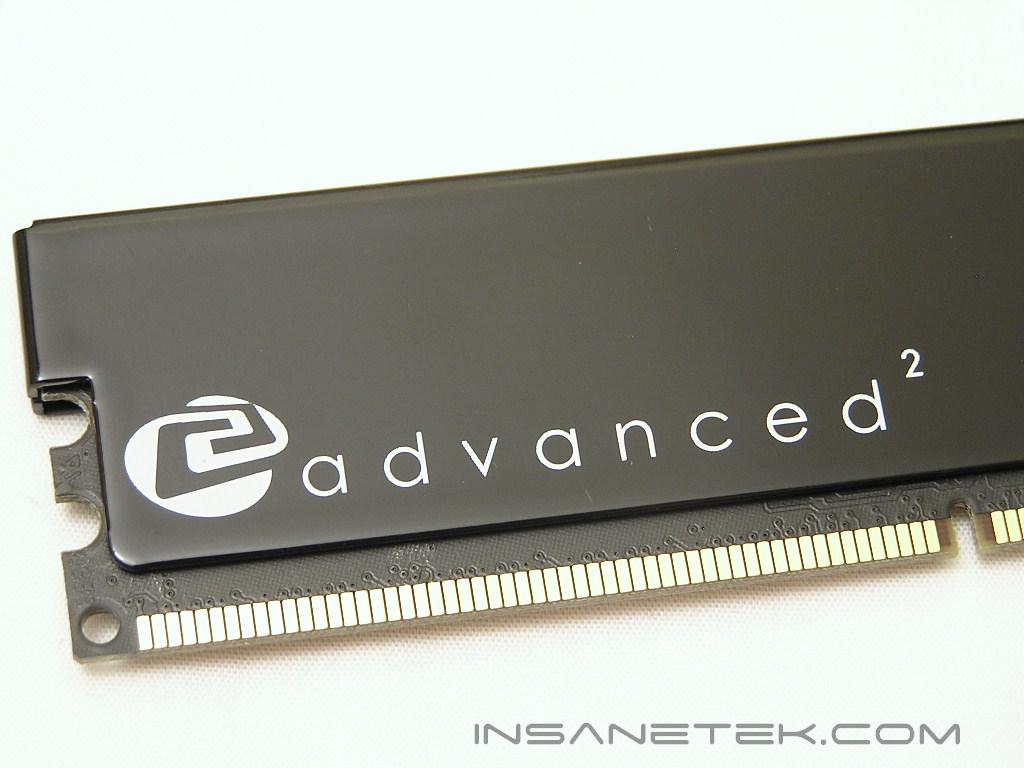
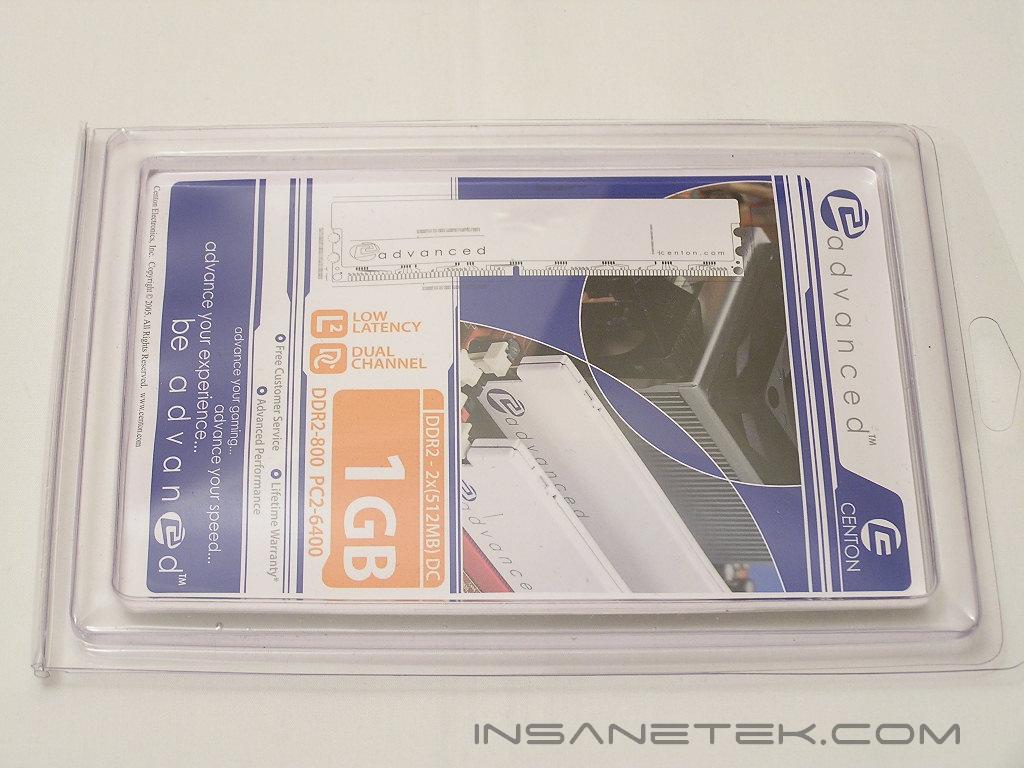
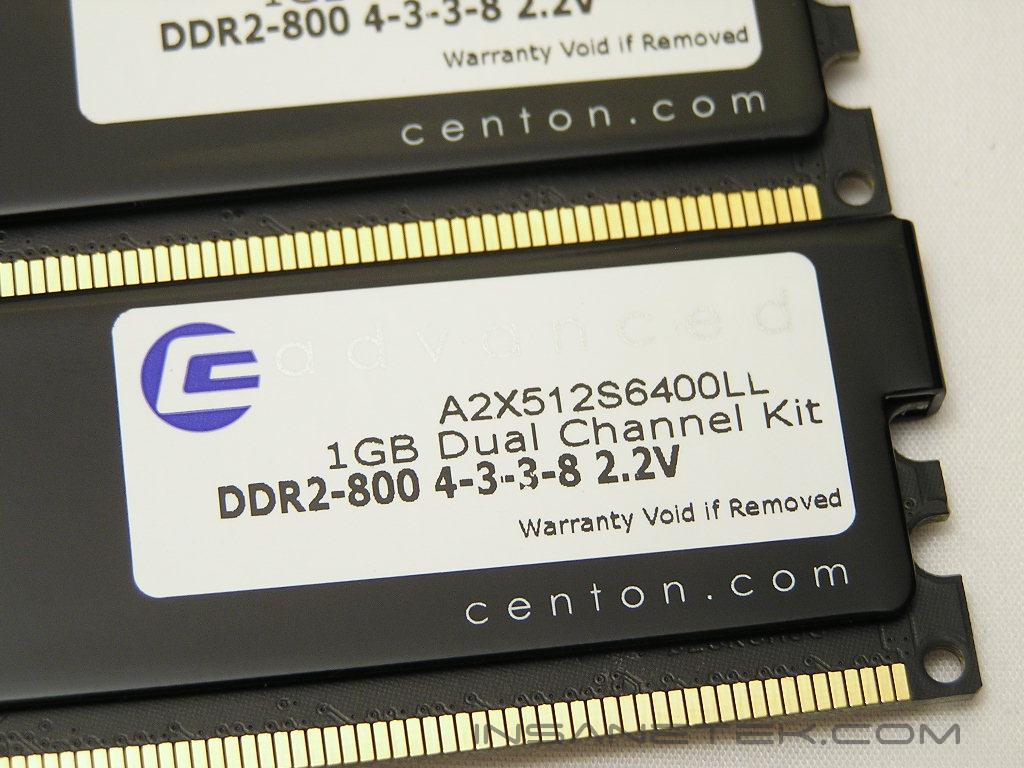
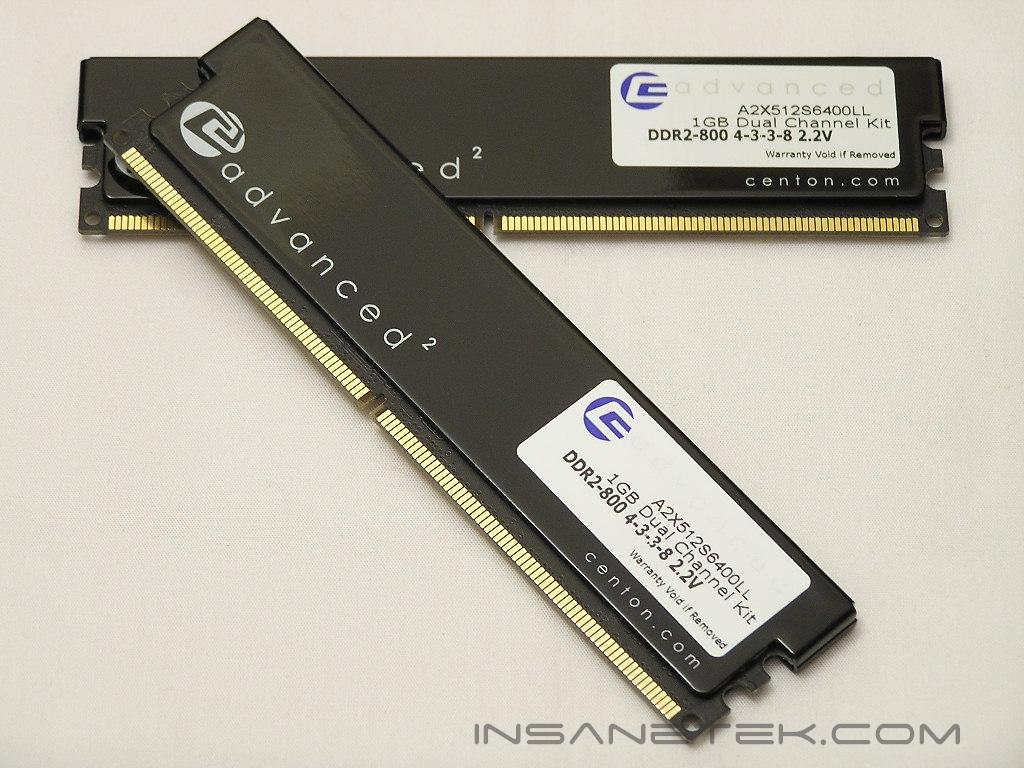
The Advanced PC2-6400 is enclosed in a plastic clear clamshell with a very nicely designed insert. This sort of packaging is quite common as it shows the attractive insert graphics as well as the memory modules. The Advanced DDR line uses the never-before-seen white copper heatspreaders. The Advanced DDR2 line comes with sexy black copper heatspreaders. It is a nice way to distinguish the two types of memory isn’t it? The heatspreaders have a glossy black finish and is quite shiny. These are honestly the best looking heatspreaders I have laid eyes on. Best of all, I don’t see fingerprints when I touch them!
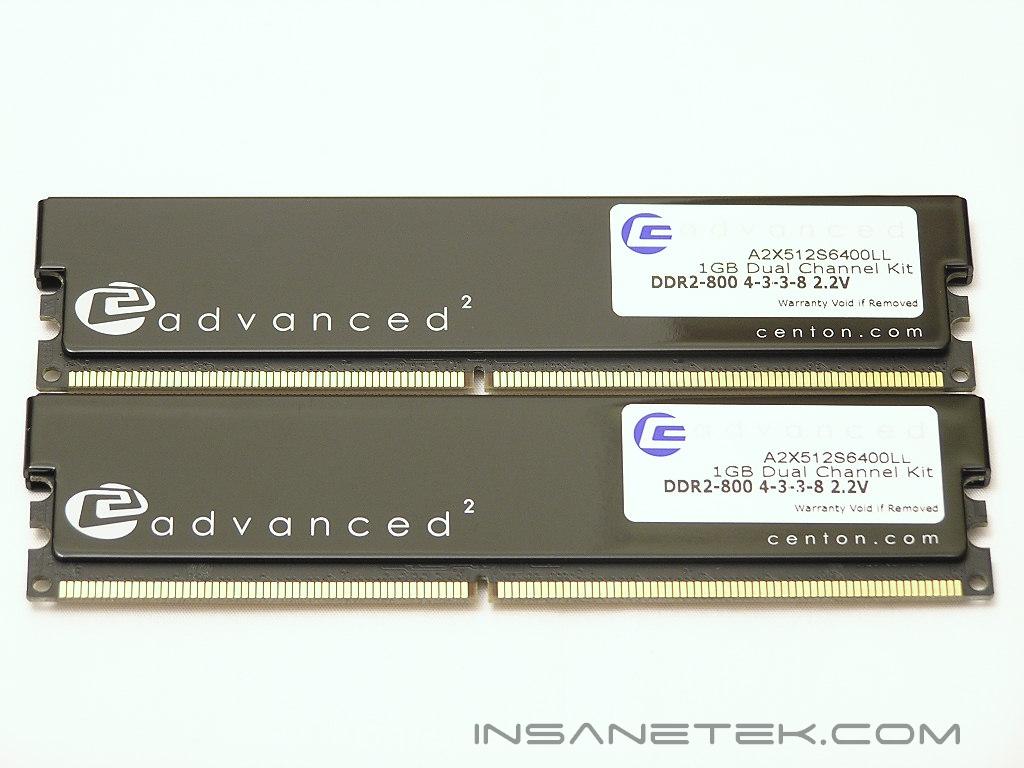
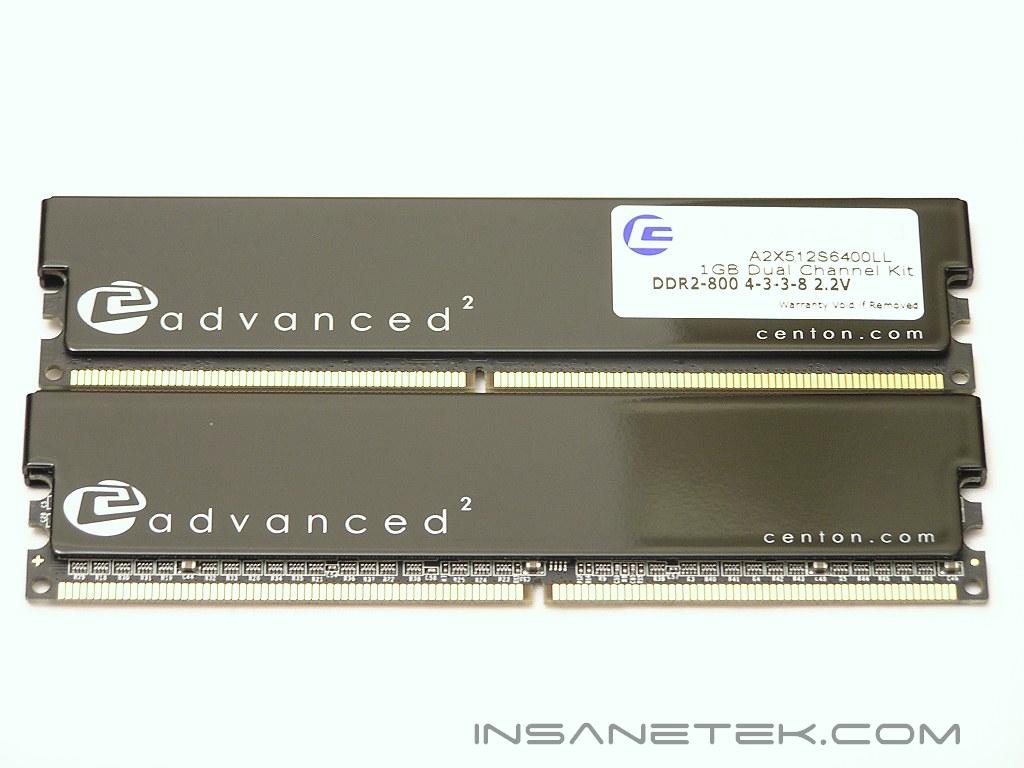
The memory is rated at a speed of 400MHz, or DDR2-800, with timings of 4-3-3-8 at a voltage range of 1.9v-2.2v. The PC2-6400 uses the famous Micron fatbody D9 ICs, D9DQW to be exact. These ICs are the best DDR2 ICs so far in terms of overclocking and running low latencies. There is word that new stuff has released, but I have yet to see them. Since Micron D9s are great at running low latencies and also great at running high speeds, 1.9v might be a somewhat on the low side of the voltage rating. The ICs respond well to increased voltage so I wouldn’t worry too much about pumping extra voltage. For those who seek to make the purchase, setting the voltage at 2.2v would be ideal. The black PCB used is a solution from Brainpower. The black PCB paired with black heatspreaders just defines elegance, in terms of aesthetics.
Test System and Overclocking
Test System:
- Intel Pentium D 840 3.2GHz
- Asus P5WD2 Premium
- 2 x 512MB Centon Advanced PC2-6400
- ATI Radeon X800XT
- Arctic Freezer 7
- SilverStone ST65ZF
Overclocking:
Keep in mind that during overclocking, the latencies are as follows: CAS-TRCD-TRP-TRAS
Throughout all tests, the multiplier has been kept at 14x to reduce any possible CPU bottleneck.
With the use of Micron D9 ICs, it is only evident that the memory is capable of running the lowest latencies of 3-2-2-5. I dropped the FSB to 200MHz and used the standard 3:4 divider, resulting with a 266MHz memory frequency. Sure enough, the memory ran these low latencies perfectly fine. My next step was to find the highest speed the memory would run at such low latencies. Using the 3:5 memory divider, I cranked up the FSB slowly and hit a wall at 240MHz, resulting with a memory speed of 340MHz, or DDR2-680. This is not the highest I have seen, but still quite good considering that it is running slightly faster than PC2-5400 memory and with lower latencies. Intel systems have been reported to benefit greatly from running the timing TRCD and TRP at 2. Keeping those timings intact, I loosened the CAS latency to 4 and TRAS to 8. The memory still refused to budge. While other fatbody D9 solutions were capable of getting a little more performance out of running 4-2-2-8, these sticks just show that fatbody D9s do not perform exactly the same. They are very similar, but not pound for pound.
The next latency test will be 3-3-2-8. This is not as tight as the other sets of timings, but still much better than the standard 3-3-3-8. Still keeping the memory divider at 3:5, the memory finally budged and gained another 15MHz, resulting with 355MHz or DDR2-710. I loosened the CAS back to 4 and finally began to see some great numbers. The Advanced PC2-6400 jumped to a good 444MHz, or DDR2-888. This result shows that the memory can run better timings than what it is rated at. It also shows that it can run at higher speeds with these timings than what it is rated at. I loosened the timings even further to 4-3-3-8 and managed to gain another 15MHz. It seems like the memory inches slowly, bit by bit. With even looser timings of 5-3-3-9, the memory jumped to a nice 490MHz, or DDR2-980. This is just a little shy from the 1GHz mark. The goal is getting close now! Unfortunately, the Advanced PC2-6400 did not see the 1GHz light. Very loose timings of 5-4-4-9 and 5-5-5-10 provide no help whatsoever.
Overclocking Results:
- 200FSB 3:4 266MHz 3-2-2-5 2.3v
- 204FSB 3:5 340MHz 3-2-2-5 2.3v
- 213FSB 3:5 355MHz 3-3-2-8 2.3v
- 222FSB 1:2 444MHz 4-3-2-8 2.3v
- 225FSB 1:2 450MHz 4-3-3-8 2.3v
- 245FSB 1:2 490MHz 5-3-3-9 2.3v
Results
A series of memory intensive benchmarks will be run to test the performance of our sample. The other tests will be based on common benchmark programs, such as 3DMark and PCMark. Real life performance differences will be tested through current games, such as Far Cry and UT2004. Memory bandwidth benchmarks will be based off of SiSoft Sandra and Everest Home Edition. Super PI and PiFast will also be used to test memory performance, as the benchmark benefits largely from FSB increases.
SiSoft Sandra Memory Bandwidth
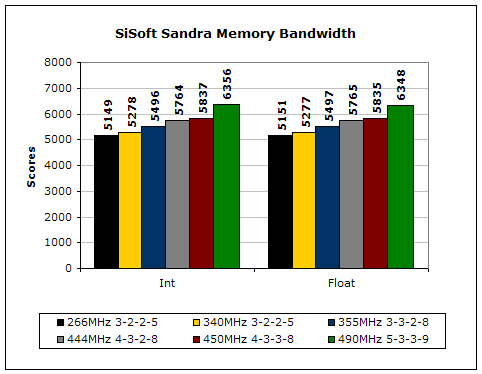
SiSoft Sandra is the most widely used memory bandwidth test. It can tell you the increase in performance from just lowering the latency timings.
Everest Home Edition
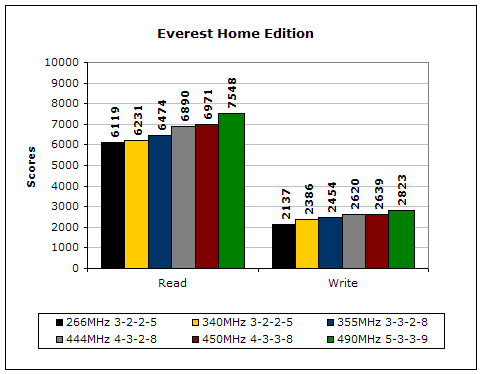
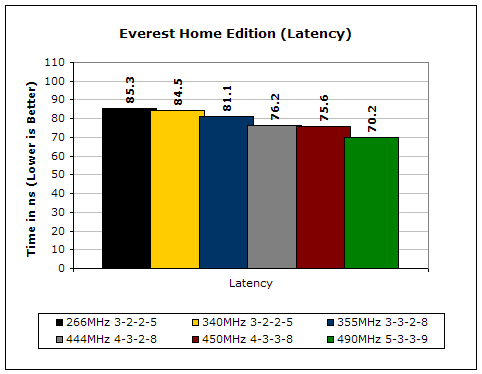
Much like Sandra, Everest Home Edition tests the memory’s ability to read and write data in large chunks. The results show that the lower latencies seem to help just a little with performance.
3DMark2001SE
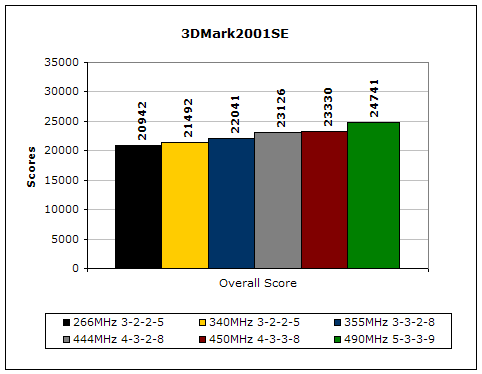
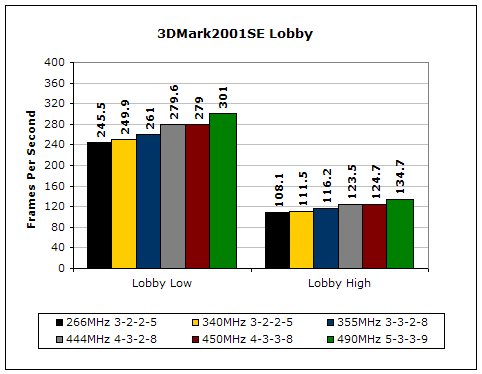
3DMark is likely the overclocker’s favorite benchmark. Unlike 3DMark2003, which stresses mainly the video card, 3DMark2001SE tests all of the system’s main components. Increasing the CPU speed, memory speed, and video card speeds will result in higher results in the final score.
Results Continued
Far Cry
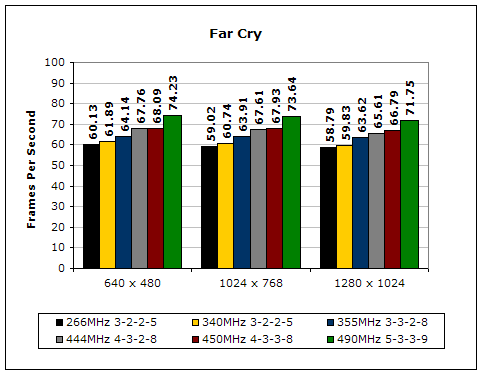
Since Far Cry is a game, the performance results will be very similar to 3dMark2001. I ran the benchmark at 640x480, so the benchmark would not be too GPU dependent. The tests under 1024x768 and 1280x1024 are an approximation of what kind of frames you’ll be getting. While the results are similar to 3dMark2001 in performance, this benchmark will give more significant results, because Far Cry is extremely demanding.
Unreal Tournament 2004
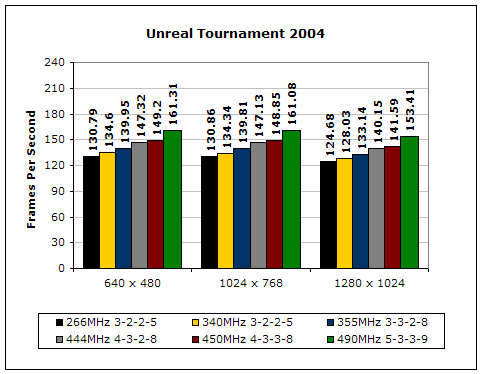
Unreal Tournament is another popular game engine to test overall system performance. Here, we can see the same results as Far Cry and 3dMark2001. Like Far Cry, UT2004 was also run at 640x480 to limit GPU dependency. The other resolutions provide an approximation of actual gameplay performance.
PCMark2002
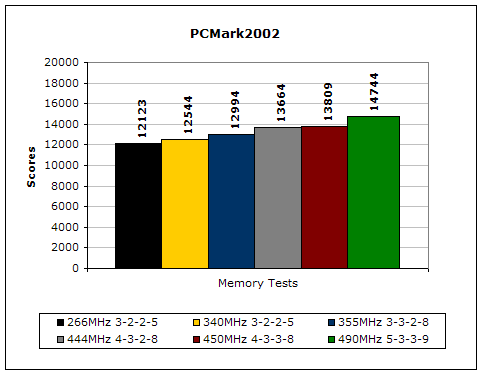
PCMark is another benchmark created by Futuremark. It tests the memory compression and decompression speeds in small to large chunks of data.
Super PI
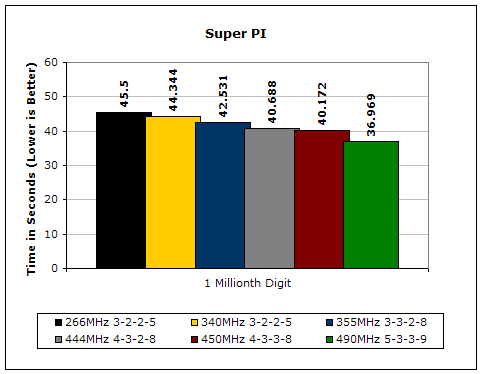
Since the value of PI is an infinite value, Super PI is a speed test to find the digit you’re looking for. In this case, we chose the millionth digit. Super PI benefits greatly from higher FSB, as well as low latencies.
PiFast
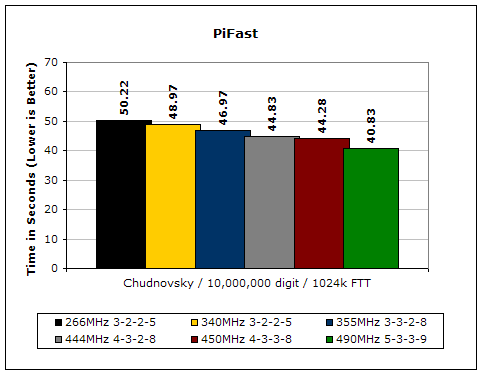
PiFast is similar to Super PI. The results can be greatly affected by a slight adjustment to the memory megahertz and latency.
Conclusion and Thoughts
Centon has done another great job with their Advanced line, this time with DDR2. They know what’s good for the enthusiasts and they give it to them. The Micron fatbody D9 based PC2-6400 is a good overclocker and runs at the lowest latencies possible. Although it did not reach the 1GHz mark, it did certainly come close. The sexy black heatspreaders and black PCB look great together. It might not look too crazy in a windowed case, but it will certainly add elegance. The Advanced PC2-6400 proves worthy as a fierce competitor and will give leading enthusiast memory providers some headaches if this news reaches the masses. The memory did not win any crowns and did not take down Corsair for the top spot, but with a very affordable price tag of just ~$175, how can it be bad? It is awesome, or as I would like to call it, PIMPTASTIC.
Pros:
- Beautiful black heatspreaders
- Excellent affordable price
- Good overclocking results
Cons:
- Availability
- Couldn’t break the 1GHz barrier (my consistent nitpick)

We would like to thank Centon for providing us the sample. If you have any questions or comments, feel free to hit us up in the forums. You can also check out more of our latest reviews on the front page.